Analyzing the Nematic Liquid Crystal Droplet with an Improved Diffuse-interface Landau--de Gennes Model
Abstract
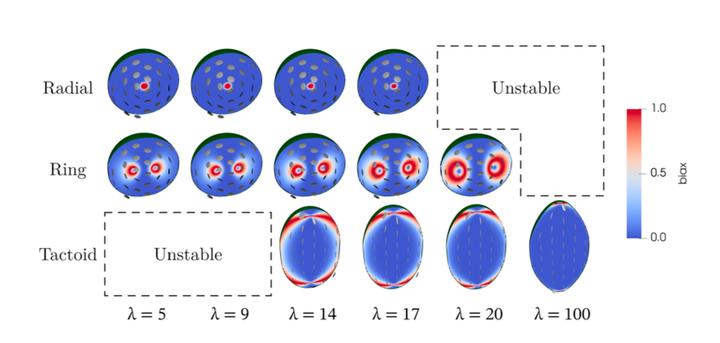
The nematic liquid crystal droplet problem is of significant interest due to the complex interplay between variable droplet shapes and orientation fields, with numerous applications in physics and material science. Here we introduce an improved diffuse-interface Landau–de Gennes model for nematic liquid crystal droplets, which eliminates an artificial penalty term from [Wu et al., SIAM J. Math. Anal., 57 (2025), pp. 4358–4395] that is inconsistent with the classical droplet problem. We prove the existence of minimizers and textbackslashGamma-convergence to a physically interpretable sharp-interface energy functional. We also present asymptotic solutions across the interface between the interior nematic droplet and external isotropic phase. Numerical simulations reveal optimal droplet configurations—radial, ring, and tactoid—highlighting the mutual influence between topological defects and droplet morphology. Furthermore, we construct a phase diagram of (meta)stable configurations as a function of temperature and domain size, delineating distinct stability regimes for biaxial and uniaxial phases.